Commercial Auto Insurance Costs: Coverage Limits and Small Fleet Requirements
Learn how commercial auto insurance policy structures, Gross Vehicle Weight Ratings (GVWR), and Hired and Non-Owned Auto (HNOA) coverage affect small fleet premiums.
› See more details ⌄ › See more details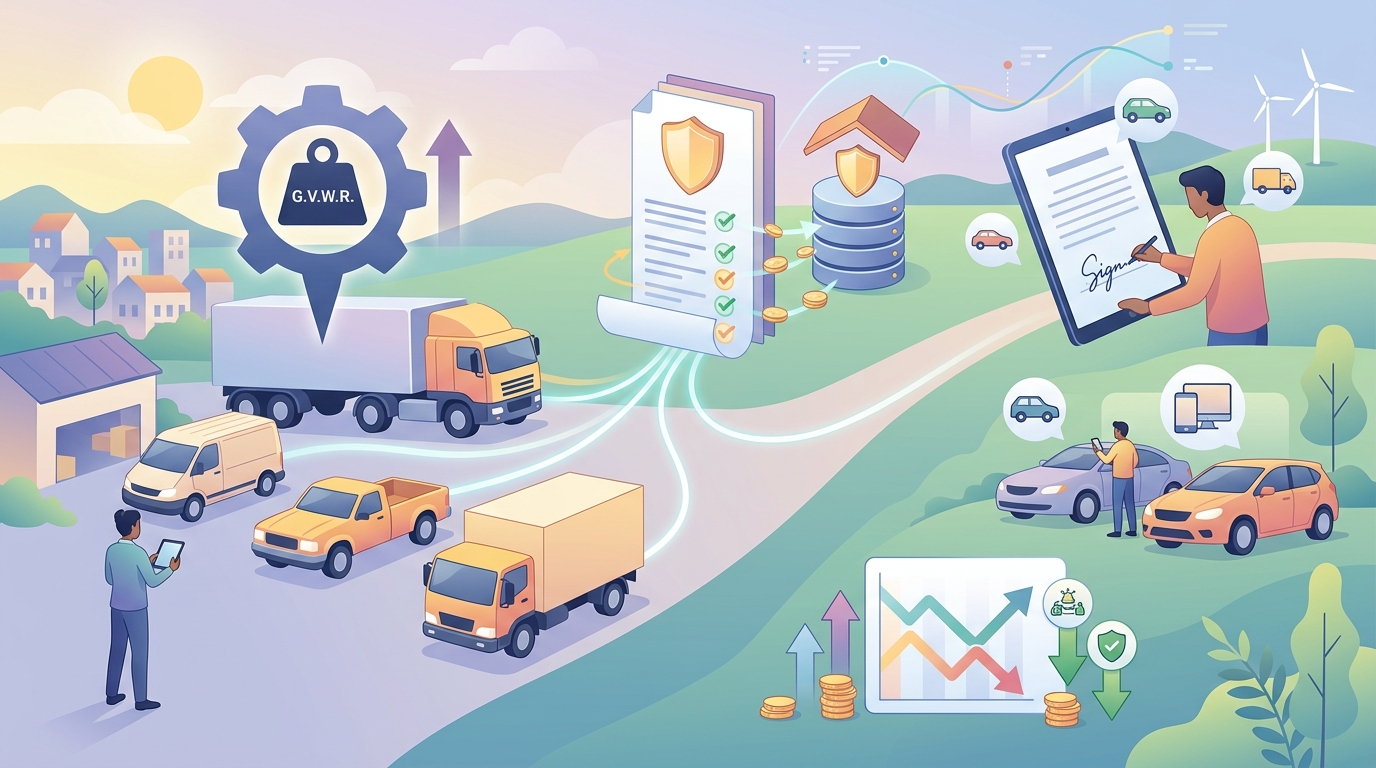
Personal Auto vs. Commercial Auto Insurance Policies
Small business owners often assume that standard personal vehicle policies extend coverage to daily business operations. However, personal auto insurance policies contain standard commercial use exclusions. If an employee involved in a crash is performing job-related tasks, transporting goods for compensation, or driving a vehicle registered to a corporation, personal insurance carriers typically deny the claim. Operating without dedicated business coverage leaves companies vulnerable to direct civil liability for property damage, legal defense expenses, and medical costs.
Commercial auto insurance policies are structured specifically to absorb the higher legal and financial risks associated with business operations. Unlike personal policies, business auto policies (BAPs) provide higher financial liability limits, cover multiple permissive users across a fleet, and accommodate specialized equipment installed on vehicles. Federal regulatory guidelines emphasize that commercial entities must maintain transparent risk management standards when deploying vehicles for commercial gain (Source 1).
Vehicle Weight Classifications and Mandatory Liability Limits
A vehicle's Gross Vehicle Weight Rating (GVWR) dictates regulatory requirements and minimum mandatory insurance limits. Federal and state regulations group commercial vehicles into light-duty, medium-duty, and heavy-duty categories. State insurance departments and the Federal Motor Carrier Safety Administration (FMCSA) set strict liability thresholds based on vehicle weight and cargo type.
- Light-Duty Vehicles (Under 10,000 lbs GVWR): Includes passenger sedans, pickup trucks, and small cargo vans used by contractors, realtors, or service technicians.
- Medium-Duty Vehicles (10,001 to 26,000 lbs GVWR): Includes box trucks, delivery vans, and large flatbeds. Drivers operating vehicles in interstate commerce above 10,000 lbs must follow specific safety standards.
- Heavy-Duty Vehicles (Over 26,001 lbs GVWR): Includes semi-trucks, heavy dump trucks, and large transport rigs requiring commercial driver's licenses (CDLs).
Required small fleet auto liability coverage increases significantly with vehicle size. For intrastate non-hazardous freight under 10,000 lbs GVWR, state mandatory minimums range from $30,000 to $100,000 in general liability. For vehicles exceeding 10,000 lbs operating across state lines, FMCSA regulations require minimum public liability coverage between $750,000 and $1,000,000 for general freight, increasing to $5,000,000 for hazardous material transports, according to department of transportation filings.
Policy Structures: Combined Single Limit (CSL) vs. Split Limits
When choosing a business auto policy, fleet managers must select between two primary liability configurations: Split Limits and Combined Single Limits (CSL).
Split limits divide liability coverage into three capped caps: bodily injury per person, total bodily injury per accident, and property damage per accident. For example, a policy written as 100/300/50 pays up to $100,000 for injuries per individual, $300,000 total for all injuries in one incident, and $50,000 for property damage. While split limits usually carry lower annual premiums, severe accidents involving expensive modern vehicles or complex personal injuries can quickly exhaust these individual limits, leaving the business owner responsible for the remaining balance.
Combined Single Limits (CSL) establish a single maximum payout figure for all bodily injury and property damage claims resulting from a single accident. A $1,000,000 CSL policy will pay out up to $1,000,000 total, regardless of how the expenses are divided between medical bills and physical vehicle repairs. Insurance underwriters frequently recommend CSL policies for small fleets because they eliminate payout bottlenecks in catastrophic claims, offering broader liability protection for commercial operations.
Hired and Non-Owned Auto Insurance (HNOA) Explained
Hired and Non-Owned Auto Insurance (HNOA) is a critical endorsement for businesses that rely on vehicles not directly owned by the company. HNOA coverage protects the business entity if a third party sues over an accident involving leased, rented, or employee-owned personal vehicles used for company errands.
- Hired Auto Coverage: Protects against third-party liability claims when the business rents, hires, leases, or borrows vehicles for operational needs (e.g., renting a box truck for a trade show).
- Non-Owned Auto Coverage: Protects the business when employees drive their personal cars to complete work duties, such as picking up office supplies, visiting client sites, or making deliveries.
It is important to note that HNOA insurance protects the company, not the individual driver. If an employee causes an accident in their personal vehicle while running a business errand, the employee's personal auto policy primary limits pay first. If damages exceed the employee's personal policy limits, the company's HNOA policy covers the excess legal liability assigned to the employer. HNOA does not cover physical damage to the employee's personal car; that remains the driver's personal collision responsibility.
Primary Cost Drivers of Business Auto Policy Premiums
Commercial auto insurance costs vary based on risk profiles evaluated by insurance underwriters. Rates reflect industry risk categories, business location, historical claims history, vehicle types, and operating conditions. Small business owners should understand these core rating metrics:
1. Driver Motor Vehicle Records (MVRs): Driver history is one of the heaviest factors in policy pricing. Insurers evaluate motor vehicle records for all listed drivers over a rolling three- to five-year window. Drivers with tickets, speeding violations, or at-fault accidents increase fleet premiums. Businesses that hire drivers with severe moving violations or DUIs face higher rates or policy exclusion endorsements.
2. Vehicle Type, Use, and Replacement Value: Heavy-duty work trucks and specialized utility vehicles require higher liability premiums due to their potential to inflict serious damage in accidents. Additionally, vehicles equipped with specialized machinery (such as hydraulic lifts, cranes, or refrigeration units) incur elevated physical damage costs for comprehensive and collision endorsements.
3. Radius of Operation: Insurers classify fleets by their typical operating radius: local (within 50 miles), intermediate (51 to 200 miles), and long-distance (over 200 miles). Vehicles traveling long distances on major interstate highways spend more time on the road at high speeds, increasing loss exposure and driving up premiums.
Evaluating Small Fleet Coverage Needs Across Industries
Coverage needs and baseline commercial auto insurance costs vary by industry. Business requirements differ based on passenger transport, cargo hazards, vehicle counts, and contract terms with general contractors or clients.
| Industry Sector | Typical Fleet Composition | Recommended Liability Structure | Key Underwriting Considerations |
|---|---|---|---|
| Residential Trade Contractors | 2-5 Pickup trucks, service vans | $1,000,000 Combined Single Limit | Tool transport, ladder rack extensions, employee driving logs |
| Local Courier & Delivery | 3-8 Cargo vans, light box trucks | $750,000 - $1,000,000 CSL | High stop frequency, urban driving hazards, tight delivery windows |
| Professional Services | Employee personal vehicles (HNOA) | $500,000 - $1,000,000 HNOA Endorsement | Employee personal policy verification, sales call travel radius |
| Heavy Freight Transport | Semi-tractors, large trailers | $1,000,000 - $5,000,000 CSL + Umbrella | CDL compliance, FMCSA filings, hazardous material classifications |
Actionable Steps to Lower Commercial Fleet Premiums
Fleet managers can lower commercial auto liability coverage costs by implementing proactive risk-management programs. Insurers reward businesses that reduce operational risk with lower premium rates.
First, establish strict driver hiring guidelines. Require mandatory Motor Vehicle Record (MVR) checks prior to extending job offers, and set clear standards for acceptable driving records. Removing high-risk drivers from commercial vehicle access lowers overall policy rates.
Second, install telematics and fleet tracking technology. Modern telematics devices monitor real-time driving behaviors, including hard braking, rapid acceleration, excessive speeding, and cornering. Insurers often offer discounts ranging from 5% to 15% according to industry rating schedules for fleets using approved telematics programs.
Third, implement routine preventive maintenance protocols. Regular inspections of brakes, tires, lights, and steering systems reduce accident risks caused by mechanical failures. Keeping detailed maintenance logs demonstrates sound risk management during annual carrier audits (Source 1).
Fourth, consider restructuring policy deductibles. Increasing physical damage deductibles (comprehensive and collision) from $500 to $1,000 or $2,500 can significantly reduce annual physical damage premiums for small fleets, provided the business maintains sufficient cash reserves to handle out-of-pocket expenses during a claim.
Why does personal auto insurance fail to cover business activities?
Personal auto insurance policies exclude commercial risks because business driving involves higher mileage, heavier vehicle loads, and increased liability exposure. When an accident occurs during business operations, personal carriers usually deny coverage based on commercial use exclusions.
What is the difference between Combined Single Limit and Split Limit coverage?
Split limits cap payouts into separate categories for bodily injury per person, bodily injury per accident, and property damage. Combined Single Limit (CSL) provides one overall dollar limit for all bodily injuries and property damage resulting from an accident, offering flexible protection for large claims.
Is Hired and Non-Owned Auto Insurance (HNOA) necessary if employees drive their own cars?
Yes. If an employee causes an accident while performing work duties in a personal vehicle, injured third parties can sue the employer. HNOA protects the business entity from excess liability claims that exceed the employee's personal auto policy limits.
Sources
- Business Guidance Resources — Federal Trade Commission
This article is for general information only and is not professional advice. Figures come from public sources and change over time; check the official source before you act.
More from Real Insight Today
- SBA 7(a) vs. SBA 504 Loans: Interest Rates, Fees, and Qualification Guide
- Bariatric Surgery Out-of-Pocket Costs: Insurance Coverage Rules and Criteria
- Revocable Living Trust vs. Will: Cost, Probate Protection, and Estate Tax Guide
- Enterprise VoIP and UCaaS Pricing: Selection and Licensing Guide for Businesses
- International Medical Evacuation Insurance: Policy Limits, Costs, and Coverage Exclusions
- Commercial Auto Insurance Costs: Coverage Limits and Small Fleet Requirements