Heat Pump Conversion Guide: Costs, Rebates, and Federal Tax Credits (Section 25C)
A comprehensive financial roadmap for converting to electric heat pumps, detailing equipment costs, efficiency metrics, federal Section 25C tax credits, and state rebate programs.
› See more details ⌄ › See more details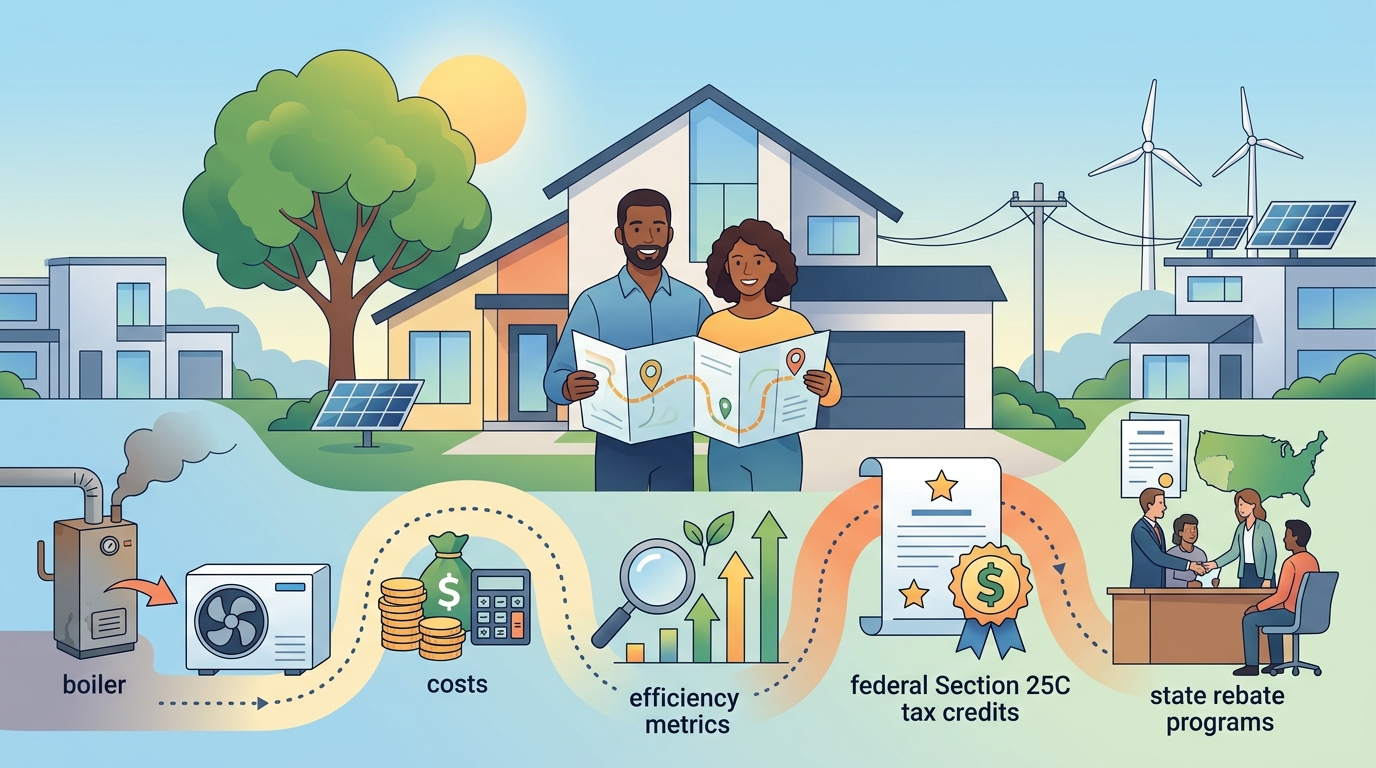
Introduction to Heat Pump Conversions
Replacing an aging heating, ventilation, and air conditioning (HVAC) system is one of the largest physical and financial investments a homeowner will make. As energy standards evolve and fuel prices fluctuate, electric heat pumps have emerged as a primary alternative to conventional combustion furnaces and central air conditioners. Modern heat pumps do not generate heat directly through combustion or electric resistance; instead, they extract thermal energy from outside air or the ground and transfer it indoors during winter, reversing the process to cool homes during summer.
The transition from fossil-fuel systems—such as natural gas, heating oil, or propane—to electric heat pumps involves complex decisions regarding system design, electrical capacity, and financial incentives. Federal legislation, including the Inflation Reduction Act, has structured financial incentives to lower the upfront installation costs for homeowners. Understanding equipment efficiency ratings, installation cost variables, tax credit mechanics, and regional rebate programs allows property owners to evaluate the return on investment accurately.
Demystifying Efficiency Metrics: SEER2, HSPF2, and COP
Evaluating heat pump performance requires understanding modern energy efficiency metrics standardized by the U.S. Department of Energy (DOE). In January 2023, the DOE updated testing procedure standards to better reflect real-world operating conditions, establishing SEER2 and HSPF2 ratings to replace the legacy SEER and HSPF standards.
Seasonal Energy Efficiency Ratio 2 (SEER2) measures cooling efficiency over a typical cooling season. It is calculated by dividing the total cooling output (measured in British Thermal Units, or BTUs) by the total electrical energy input (measured in watt-hours). Higher SEER2 ratings indicate greater electrical efficiency during summer months. Standard heat pumps generally range from 14.3 SEER2 to 24 SEER2.
Heating Seasonal Performance Factor 2 (HSPF2) measures heating performance over a typical heating season. Similar to SEER2, it compares total heating output in BTUs to total electrical consumption in watt-hours. Modern high-efficiency heat pumps generally feature HSPF2 ratings between 7.5 and 10.0 or higher. For cold climates, the Coefficient of Performance (COP) provides an additional snapshot of efficiency at specific outdoor temperatures (such as 5°F or 47°F). A COP of 2.0 indicates that the system produces twice as much thermal energy as the electrical energy it consumes.
Heat Pump Installation Costs: Standard vs. Cold-Climate Units
The total installed cost of a heat pump system varies based on equipment type, home size, geographic region, existing ductwork infrastructure, and climate requirements. Heat pumps fall primarily into two mechanical categories: standard air-source systems and cold-climate air-source systems (CCHPs).
Standard heat pumps operate efficiently in regions where winter temperatures rarely drop below freezing for extended periods. When outdoor temperatures drop significantly, standard systems rely on auxiliary electric resistance heating, which increases power consumption. Cold-climate heat pumps employ variable-speed inverter compressors and specialized refrigerants, allowing them to deliver significant heating output even when ambient outdoor temperatures fall below -10°F.
| System Type | Equipment & Labor Range | Target Climate Zone | Key Performance Characteristic |
|---|---|---|---|
| Standard Ducted Heat Pump | $4,500 – $9,500 | DOE Zones 1–4 (Mild to Moderate) | Requires supplemental heat source below 25°F |
| Cold-Climate Ducted Heat Pump | $8,000 – $18,000 | DOE Zones 5–7 (Cold/Subarctic) | Maintains high COP down to sub-zero temperatures |
| Ductless Multi-Zone Mini-Split | $6,000 – $14,000 | All Climate Zones (Zoned Heating) | Eliminates duct losses; individual room controls |
| Geothermal (Ground-Source) | $18,000 – $35,000+ | All Climate Zones | Uses ground loops for high year-round efficiency |
Federal Section 25C Tax Credit Criteria and Rules
Under the Energy Efficient Home Improvement Credit (Section 25C of the Internal Revenue Code), qualified homeowners can claim a federal tax credit for installing qualifying heat pumps and heat pump water heaters (Source 1). The Section 25C credit allows taxpayers to deduct 30% of the total project cost—including both equipment and labor—up to a maximum annual limit of $2,000 per tax year for heat pumps (Source 1).
This credit is nonrefundable, meaning it can reduce a taxpayer's total income tax liability to zero, but any excess credit cannot be carried forward to future tax years (Source 1). Unlike the previous lifetime cap under prior tax law, Section 25C establishes an annual cap (Source 1). This allows homeowners to spread energy efficiency upgrades over multiple tax years—for example, installing a heat pump water heater in one year and a central heat pump space heating system in a subsequent year—and claim up to the annual $2,000 limit in each year (Source 1).
To qualify for the Section 25C tax credit, heat pump equipment must meet or exceed specific efficiency thresholds set by the Consortium for Energy Efficiency (CEE). Specifically, the unit must meet the highest efficiency tier (excluding advanced tiers) established by CEE as of the beginning of the calendar year in which the equipment is placed in service (Source 1). Homeowners must claim the credit on IRS Form 5695 filed with their annual federal tax return for the tax year in which installation was completed (Source 1).
State-Level Inflation Reduction Act Rebates: HOMES and HEEHRA
In addition to federal tax credits, the Inflation Reduction Act authorized funding for two state-administered rebate programs designed to lower upfront financial barriers for residential energy improvements: the High-Efficiency Electric Home Rebate Act (HEEHRA) and the Home Owner Managing Energy Savings (HOMES) program.
HEEHRA provides point-of-sale discounts specifically targeted at low- and moderate-income households. Household eligibility is determined relative to the Area Median Income (AMI). Households earning less than 80% of AMI can receive rebates covering up to 100% of qualified heat pump installation costs, up to a maximum cap of $8,000. Households earning between 80% and 150% of AMI can receive rebates covering up to 50% of installation costs, up to the same $8,000 maximum.
The HOMES program provides performance-based rebates to any single-family or multi-family homeowner, regardless of income, based on the measured or modeled energy savings achieved through whole-house retrofits. System upgrades achieving modeled energy savings of at least 20% to 35% can qualify for rebates ranging from $2,000 to $4,000, with higher rebate caps available for low-income properties.
| Incentive Program | Funding Structure | Income Threshold | Maximum Heat Pump Benefit |
|---|---|---|---|
| Section 25C Tax Credit | Federal Tax Credit | No Income Cap | 30% of cost up to $2,000 annually (Source 1) |
| HEEHRA Rebate (Low-Income) | Point-of-Sale Rebate | < 80% Area Median Income | 100% of cost up to $8,000 |
| HEEHRA Rebate (Moderate-Income) | Point-of-Sale Rebate | 80% – 150% Area Median Income | 50% of cost up to $8,000 |
| HOMES Program | Performance-Based Rebate | No Income Cap (Higher for Low Inc.) | $2,000 – $8,000 (Based on energy reduction) |
Electrical Infrastructure and Service Panel Upgrades
Converting a home from fossil-fuel heating to an all-electric heat pump increases the electrical load on the home's primary electrical service. Homes constructed prior to 1980 frequently operate on 100-amp electrical service panels, which may be insufficient to support a central electric heat pump alongside traditional appliances like electric dryers, ovens, and water heaters.
Upgrading an electrical main panel from 100 amps to 200 amps typically costs between $1,500 and $4,500, depending on utility line connections, local labor rates, and municipal permit requirements based on electrical contractor fee schedules. In some cases, structural upgrades or new conduit runs from the street transformer may add to the total cost.
Financial incentives help offset these infrastructure expenses when completed alongside a heat pump installation. Section 25C offers a tax credit of 30% up to $600 for qualifying electric panel upgrades, provided the panel is installed in conjunction with and enables the primary qualified heat pump system (Source 1). Furthermore, under the HEEHRA program, eligible low- and moderate-income households can receive point-of-sale rebates up to $4,000 specifically for electrical panel upgrades and up to $1,600 for electric wiring improvements.
Operational Savings and Return on Investment (ROI)
The long-term financial payoff of converting to a heat pump depends on several variable factors: the baseline heating fuel being replaced, regional fuel prices, local electricity rates (measured per kilowatt-hour), and home insulation standards.
Homeowners transitioning from deliverable fuels such as heating oil or propane typically realize substantial annual operational savings. Because fuel oil and propane are expensive heating sources per million BTUs delivered, high-efficiency heat pumps can reduce annual heating costs by $500 to $1,500 based on standard Department of Energy efficiency modeling. Conversely, in regions with low natural gas prices and high electricity rates, converting from a modern natural gas furnace to an electric heat pump may result in comparable annual operational costs or modest operational savings.
| Baseline Heating System | Typical Heating Efficiency | Estimated Annual Fuel Cost Change | Estimated Financial Payback Horizon |
|---|---|---|---|
| Heating Oil Furnace | 80% – 85% AFUE | Savings: $600 – $1,400 / year | 4 to 7 Years |
| Propane Furnace | 80% – 90% AFUE | Savings: $500 – $1,200 / year | 5 to 8 Years |
| Electric Resistance Baseboard | 100% COP (1.0) | Savings: $800 – $1,800 / year | 3 to 6 Years |
| Natural Gas Furnace | 80% – 95% AFUE | Cost change: -$200 to +$200 / year | 8 to 12+ Years (Varies by gas rates) |
Step-by-Step Conversion Strategy
- 1. Perform a Home Energy Assessment: Schedule a professional energy audit to evaluate air leakage, insulation depth, and duct performance. Sealing envelope leaks reduces required HVAC tonnage.
- 2. Conduct Manual J Load Calculations: Ensure contractors calculate heat loss and gain scientifically rather than sizing equipment based solely on existing square footage.
- 3. Evaluate Electrical Capacity: Inspect the existing breaker panel to determine if a 200-amp service upgrade or smart load management device is necessary before installation.
- 4. Verify Incentive Eligibility: Check regional Area Median Income (AMI) thresholds for state HEEHRA rebates and confirm selected heat pump model numbers appear on CEE qualifying product lists for Section 25C tax credits (Source 1).
- 5. Obtain Itemized Contractor Bids: Ensure quotes break down equipment models, efficiency metrics (SEER2/HSPF2), labor charges, permit fees, and electrical upgrades.
- 6. File Tax Documentation: Retain itemized contractor receipts and manufacturer certification statements to file IRS Form 5695 during tax preparation (Source 1).
Can I claim both Section 25C tax credits and state HEEHRA rebates on the same installation?
Yes. Homeowners can combine federal tax credits with state or utility rebates. However, under federal tax rules, state rebates that function as point-of-sale price reductions reduce the total eligible project cost before calculating the 30% Section 25C tax credit amount (Source 1).
What efficiency rating is required for a heat pump to qualify for Section 25C?
To qualify for the Section 25C credit, split-system and package heat pumps must meet or exceed the highest non-advanced tier established by the Consortium for Energy Efficiency (CEE) in effect at the start of the installation year (Source 1).
Do heat pumps operate effectively in below-zero outdoor temperatures?
Cold-climate heat pumps (CCHPs) equipped with variable-speed inverter compressors maintain reliable heating and high efficiency in temperatures well below zero degrees Fahrenheit, significantly reducing reliance on supplemental electric heat.
Sources
- Energy Efficient Home Improvement Credit — Internal Revenue Service
This article is for general information only and is not professional advice. Figures come from public sources and change over time; check the official source before you act.
More from Real Insight Today
- SBA 7(a) vs. SBA 504 Loans: Interest Rates, Fees, and Qualification Guide
- Bariatric Surgery Out-of-Pocket Costs: Insurance Coverage Rules and Criteria
- Revocable Living Trust vs. Will: Cost, Probate Protection, and Estate Tax Guide
- Enterprise VoIP and UCaaS Pricing: Selection and Licensing Guide for Businesses
- International Medical Evacuation Insurance: Policy Limits, Costs, and Coverage Exclusions
- Commercial Auto Insurance Costs: Coverage Limits and Small Fleet Requirements