SBA 7(a) vs. SBA 504 Loans: Interest Rates, Fees, and Qualification Guide
A direct comparison of SBA 7(a) and SBA 504 loans, analyzing loan limits, interest rate caps, upfront guaranty fees, down payment rules, and processing timelines for small business owners.
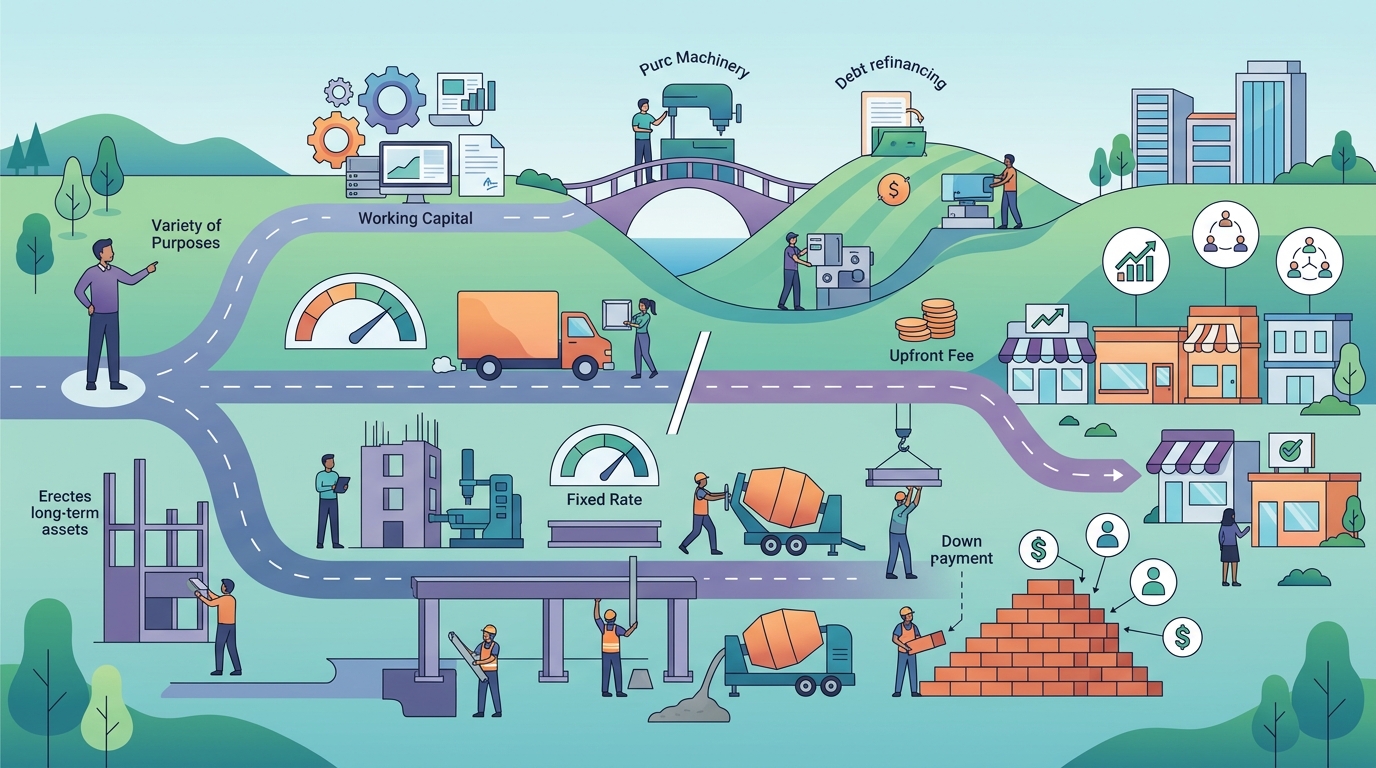
Understanding Federal Financing Programs for Small Businesses
Small business owners seeking long-term capital frequently evaluate federal commercial loan programs supported by the U.S. Small Business Administration (SBA). These loan programs lower financial risk for commercial lenders, enabling business owners to access capital with lower down payments and longer repayment terms than non-guaranteed commercial financing (Source 1). Federal guidance highlights that matching the correct loan structure to commercial goals prevents cash flow strain and unnecessary debt costs (Source 1).
The two main funding mechanisms available through SBA lending partners are the SBA 7(a) loan program and the SBA 504 loan program. While both programs aim to expand access to capital, they feature distinct capital structures, rate mechanics, allowed uses of funds, and fee schedules (Source 1). Selecting between them requires analyzing project scope, asset type, fixed versus variable interest exposure, and required equity injections.
Maximum Loan Amounts and Permissible Uses of Funds
The primary distinction between the SBA 7(a) and SBA 504 programs lies in how funds may be legally utilized within a business. The SBA 7(a) program serves as a broad financing mechanism designed for general business operations, capital expenditures, and working capital needs (Source 1). The maximum loan amount for a standard SBA 7(a) loan is $5,000,000.
Permissible uses for SBA 7(a) loan proceeds include:
- Short-term and long-term working capital needs
- Purchasing inventory, supplies, raw materials, and operational equipment
- Refinancing existing high-interest business debt under qualifying guidelines
- Acquiring an existing business, buying out a business partner, or funding franchise fees
- Purchasing, constructing, or renovating commercial real estate occupied by the business
In contrast, the SBA 504 loan program is strictly dedicated to long-term economic development and fixed-asset acquisition (Source 1). Borrowers cannot use 504 funds for general working capital, inventory, or debt refinancing outside of specific real estate expansion guidelines. The maximum loan amount for the SBA portion (debenture) of a 504 project is $5,000,000 for standard projects and up to $5,500,000 for specialized energy-public policy projects or small manufacturers.
Because the SBA 504 program uses a multi-layered funding structure—combining a private lender loan, a Certified Development Company (CDC) debenture, and a borrower equity contribution—the total project size can easily exceed $10,000,000 to $15,000,000.
Permissible uses for SBA 504 loan proceeds include:
- Buying owner-occupied commercial real estate, land, or existing buildings
- Constructing new facilities or modernizing existing real estate structures
- Purchasing heavy machinery and major equipment with a long useful lifespan
- Upgrading site infrastructure, parking structures, utilities, or landscaping
Interest Rate Structures and Federal Rate Caps
Interest rate mechanics differ sharply between the two programs. The SBA 7(a) program offers both fixed and variable interest rate structures. Variable rates are tied to a base rate, such as the Wall Street Journal Prime Rate, the London Interbank Offered Rate (LIBOR) transition equivalents (SOFR), or the SBA Peg Rate, plus a maximum allowable spread regulated by federal rules (Source 1).
Federal regulations establish interest rate caps for SBA 7(a) loans based on the total loan amount and maturity length. For variable-rate 7(a) loans, maximum allowable spreads relative to the prime rate standard generally function as follows under standard SBA guidelines:
- Loans of $50,000 or less: Prime rate plus up to 6.50%
- Loans between $50,001 and $250,000: Prime rate plus up to 4.50%
- Loans between $250,001 and $500,000: Prime rate plus up to 3.00%
- Loans over $500,000: Prime rate plus up to 2.50%
Fixed-rate 7(a) loans use maximum allowable interest rates determined by the base rate plus fixed spreads that vary by maturity length. Because variable 7(a) loans reset periodically as the base rate shifts, borrowers face interest rate fluctuation risks during periods of monetary tightening.
The SBA 504 program uses a unique dual-rate structure due to its three-tier financing framework. The project funding is divided into three components:
- First-lien commercial bank loan: Covers 50% of total project costs. The interest rate is negotiated between the borrower and the bank, offering fixed or variable terms based on market conditions.
- Second-lien CDC debenture: Covers 40% of total project costs. This portion is fully backed by the SBA and funded through 10-year, 20-year, or 25-year debentures sold on public markets.
- Borrower down payment: Covers the remaining 10% (or higher) of project costs.
The CDC debenture portion features an all-in fixed interest rate locked in at the time the debenture is sold. This fixed rate is pegged to 10-year U.S. Treasury yields plus a small spread and ongoing servicing fees. This structure provides long-term rate predictability for commercial property acquisitions.
SBA Fee Structures: Upfront Guaranty Fees and Servicing Charges
Both loan programs carry mandatory administrative and guaranty fees established by federal statutory guidelines to fund program operations (Source 1). These fee structures vary based on loan sizing, maturity length, and program type.
For SBA 7(a) loans, the upfront guaranty fee is charged on the guaranteed portion of the loan, not the total loan amount. The SBA guarantees up to 85% for loans of $150,000 or less, and up to 75% for loans greater than $150,000. Under standard SBA fee tables, the upfront guaranty fee percentages are structured as follows:
- Loans up to $150,000: 2.00% of the guaranteed portion (often reduced or waived by policy updates)
- Loans from $150,001 to $700,000: 3.00% of the guaranteed portion
- Loans from $700,001 to $5,000,000: 3.50% of the guaranteed portion up to $1,000,000, plus 3.75% of the guaranteed portion exceeding $1,000,000
Additionally, 7(a) loans carry an ongoing annual servicing fee paid by the lender (often factored into loan pricing) assessed as a percentage of the remaining guaranteed principal balance. These fee structures can be adjusted annually by the federal government depending on budget allocations.
SBA 504 loans carry a different fee configuration split between the bank and CDC portions. Upfront 504 fees are usually financed directly into the debenture amount rather than paid out of pocket. Standard 504 fees include:
- CDC Processing Fee: 1.50% of the debenture amount
- SBA Guaranty Fee: 0.50% of the debenture amount
- Funding Fee: 0.25% of the debenture amount
- Third-Party Lender Fee: 0.50% of the commercial bank loan amount
- Ongoing Servicing Fees: Monthly fees built directly into the effective fixed rate of the debenture, including CDC servicing, central servicing agent (CSA) fees, and the SBA annual fee
| Fee Component | SBA 7(a) Program | SBA 504 Program |
|---|---|---|
| Upfront Guaranty / SBA Fee | 2.0% to 3.75% (assessed on guaranteed portion) | 0.50% (assessed on debenture portion) |
| CDC / Processing Fees | None | 1.50% CDC fee + 0.25% funding fee |
| Third-Party Bank Fee | None | 0.50% on first-mortgage commercial lender portion |
| Ongoing Annual Servicing Fee | Assessed on outstanding guaranteed balance | Included in all-in fixed debenture monthly rate |
| Financing Fee into Loan | Allowed under specific program guidelines | Upfront debenture fees are financed into debenture |
Down Payment and Equity Injection Requirements
Minimizing initial equity requirements is a key reason small business owners choose SBA loans instead of conventional commercial debt, which often demands 20% to 30% down. Federal framework guidelines outline baseline equity standards, though participating lenders may impose additional requirements based on risk (Source 1).
For standard SBA 7(a) loans, equity injection requirements vary according to the purpose of the financing:
- Working capital and equipment purchases: As low as 0% to 10% down payment depending on cash flow strength and collateral
- Business acquisitions / Change of ownership: Minimum 10% equity injection standard required by SBA guidelines
- Commercial real estate acquisitions: Typically 10% equity injection required for established businesses
For SBA 504 loans, down payment rules follow a strict statutory framework based on business history and property type:
- Standard projects: 10% borrower equity contribution for established businesses purchasing standard commercial property
- Start-up businesses: 15% equity contribution required if the business has operated for less than two years
- Single-purpose properties: 15% equity contribution required for special-purpose real estate (e.g., hotels, car washes, self-storage facilities, gas stations)
- Start-up AND single-purpose property: 20% equity contribution required if both risk factors apply
Processing Timelines, Lender Roles, and Preferred Lender Status
The time required to approve and close an SBA loan depends heavily on the chosen program and the lender's designated SBA status. Federal business guidance encourages borrowers to evaluate lender experience, as administrative requirements affect closing speed (Source 1).
Lenders participating in the SBA 7(a) program fall into two main categories: standard lenders and Preferred Lender Program (PLP) lenders. Standard lenders must submit complete loan application packages directly to the SBA government processing center for review and approval, adding two to four weeks to the timeline.
Preferred Lender Program (PLP) lenders hold delegated authority from the SBA to make final credit decisions independently. This delegated status streamlines underwriting, reduces paperwork delays, and cuts overall processing times down to 30 to 45 days. Non-PLP processing times often extend to 60 to 90 days.
SBA 504 loans follow a multi-step timeline because they require coordination between two distinct lending entities: the commercial bank providing the 50% first mortgage and the Certified Development Company (CDC) issuing the 40% SBA debenture.
The typical 504 loan approval process involves:
Because of this dual-entity structure, SBA 504 loans generally take between 60 and 90 days to close, with construction projects extending longer depending on building timelines.
Scenario Analysis: Choosing the Right Program
Selecting the optimal financing structure requires matching loan features to project goals. The following scenario comparisons illustrate how financing mechanics apply in common real-world situations.
Scenario A: Acquiring a $2,000,000 Commercial Warehouse
An established logistics company wants to purchase a $2,000,000 commercial building. Under an SBA 7(a) loan, the borrower provides a 10% down payment ($200,000), leaving a single loan of $1,800,000. The interest rate is variable (e.g., Prime + 2.50%), exposing the borrower to potential rate increases over the 25-year term. Upfront guaranty fees on the guaranteed portion (75% of $1.8M = $1.35M) would total roughly $48,125.
Under an SBA 504 loan, the funding structure splits as follows:
- Commercial Bank (50%): $1,000,000 at a competitive bank rate
- CDC Debenture (40%): $800,000 locked in at a low fixed rate for 25 years
- Borrower Down Payment (10%): $200,000 out-of-pocket contribution
In this scenario, the SBA 504 loan offers substantial interest rate stability because 40% of the project cost is locked into a long-term fixed rate. Additionally, total upfront fees on the 504 debenture portion are lower than the 7(a) guaranty fee on large real estate acquisitions.
Scenario B: Purchasing $350,000 in Equipment and Funding Working Capital
A manufacturing business needs $200,000 for specialized equipment and $150,000 for inventory and payroll expansion. Because SBA 504 loans explicitly prohibit working capital and operational inventory, the 504 program cannot fund this request. The business must use the SBA 7(a) program, which allows working capital and equipment to be combined into a single 10-year term loan.
| Feature / Criteria | SBA 7(a) Loan Program | SBA 504 Loan Program |
|---|---|---|
| Primary Purpose | General working capital, equipment, real estate, business acquisition | Fixed assets, land, commercial real estate, heavy equipment |
| Max Total Project Size | $5,000,000 max loan limit | Exceeds $10,000,000+ (CDC portion capped at $5M-$5.5M) |
| Standard Down Payment | 0% to 10% (10% standard for acquisitions/real estate) | 10% standard (15%-20% for start-ups / single-purpose properties) |
| Interest Rate Types | Variable (Prime + spread) or Fixed | Bank portion: Variable/Fixed; CDC portion: Fixed for 10-25 yrs |
| Prepayment Penalties | 3 years on real estate loans (5%, 3%, 1%) | 10-year declining penalty scale on CDC debenture |
| Average Closing Timeline | 30 to 60 days (faster with PLP lender) | 60 to 90 days (requires dual bank + CDC coordination) |
Can an owner use an SBA 7(a) loan to buy out a partner?
Yes. Partner buyouts are eligible under the SBA 7(a) program, provided the remaining owner acquires full operational control and meets SBA equity injection standards. The SBA 504 program cannot be used for partner buyouts or equity buybacks.
Can an SBA 504 loan cover working capital or inventory?
No. SBA 504 proceeds are strictly restricted to long-term fixed assets such as land, commercial facilities, site improvements, and long-life equipment. Working capital must be financed separately or through an SBA 7(a) loan.
What are the prepayment penalties for SBA 7(a) and SBA 504 loans?
SBA 7(a) loans only have prepayment penalties if the loan maturity is 15 years or longer (e.g., real estate) and paid off within the first 3 years (5% in year one, 3% in year two, 1% in year three). SBA 504 loans feature a 10-year declining prepayment penalty on the CDC debenture portion.
Sources
- Small Business Guidance — Federal Trade Commission
This article is for general information only and is not professional advice. Figures come from public sources and change over time; check the official source before you act.
More from Real Insight Today
- SBA 7(a) vs. SBA 504 Loans: Interest Rates, Fees, and Qualification Guide
- Bariatric Surgery Out-of-Pocket Costs: Insurance Coverage Rules and Criteria
- Revocable Living Trust vs. Will: Cost, Probate Protection, and Estate Tax Guide
- Enterprise VoIP and UCaaS Pricing: Selection and Licensing Guide for Businesses
- International Medical Evacuation Insurance: Policy Limits, Costs, and Coverage Exclusions
- Commercial Auto Insurance Costs: Coverage Limits and Small Fleet Requirements